Winning a retainer changes how an agency feels. Instead of chasing the next project, you have income you can count on and a client relationship that compounds. But it starts with the proposal, and a retainer proposal is not the same animal as a one-off project pitch. You are not selling a deliverable with an end date. You are asking someone to commit to paying you every month, and the proposal has to make that feel like an easy yes.
Below is how to write one that does, section by section, plus a simple template you can copy. If you would rather not build it from scratch, there is a faster route at the end.
In a hurry? Download the free retainer proposal template (or read below how to write one that wins).
In this guide8 sections
What is a retainer proposal?
A retainer proposal proposes an ongoing working relationship for a recurring fee, usually paid monthly. Rather than scoping one project with a clear finish line, you are defining a set of services you will deliver every month for an agreed period.
That difference changes how you write it. A project proposal sells an outcome. A retainer proposal sells a relationship, and clients weigh those two things differently. When someone commits to a monthly fee, they are really asking themselves whether they trust you to keep delivering value month after month without having to manage you. Everything in the proposal should answer that question.
What to include
Most strong retainer proposals share the same handful of sections. You do not need more than these, and skipping any of them tends to cause problems later.
1. Executive summary
Open by restating what the client wants to achieve, then frame the retainer as the way to get there over time. The aim is for them to read this opening and immediately understand what they are signing up for and why it helps them. Keep it about the client, not about you. A few sentences is plenty.
2. Scope and deliverables
This is the part that matters most, so be specific. “Ongoing marketing support” means nothing and invites endless requests. Something like “four blog articles, twelve social posts, monthly reporting and a strategy call” tells the client exactly what they get each month and quietly protects your time.
Just as important is naming what falls outside the retainer. Spell out the work that is out of scope and would be quoted separately, like a website rebuild or paid ad spend. It feels like a small thing, but it heads off most of the awkward “I thought that was included” conversations before they start. A good proposal keeps the monthly inclusions and the out-of-scope items side by side, so there is no ambiguity.
3. Term and renewal
Spell out how long the retainer runs and what happens at the end. A six or twelve month initial term is common, often rolling month to month afterward with thirty days notice. Putting this in writing signals that you have done this before and you plan ahead.
4. Investment
State the monthly fee plainly. If there is a one-time setup or onboarding project on top of the retainer, keep it separate so the client can see at a glance what they pay once and what recurs. The next section goes deeper on this, because it is where most retainer proposals get muddy.
5. Terms and signature
Close with short, readable terms and an easy way to say yes. The best retainer proposals let the client accept and sign in the same place they read everything else, so there is no separate contract to send and then chase.
How to price a retainer proposal
Pricing gets messy when a monthly retainer sits alongside an upfront project, which is how a lot of agency engagements actually start. A few principles keep your investment section clean.
Separate the one-time fees from the recurring ones. Say you are proposing a brand refresh to kick things off and then ongoing social management. Do not fold those into a single number. Show the project fee, show the monthly retainer, then show the combined picture, something like “$6,000 brand refresh, then $3,500 a month for twelve months.” The client should never have to do the math themselves.
Price the value, not the hours. The moment a retainer is billed by the hour, the client starts counting minutes and questioning every invoice. Pricing around the monthly deliverables and the outcome they buy keeps the conversation on what they are getting instead of how long it took you.
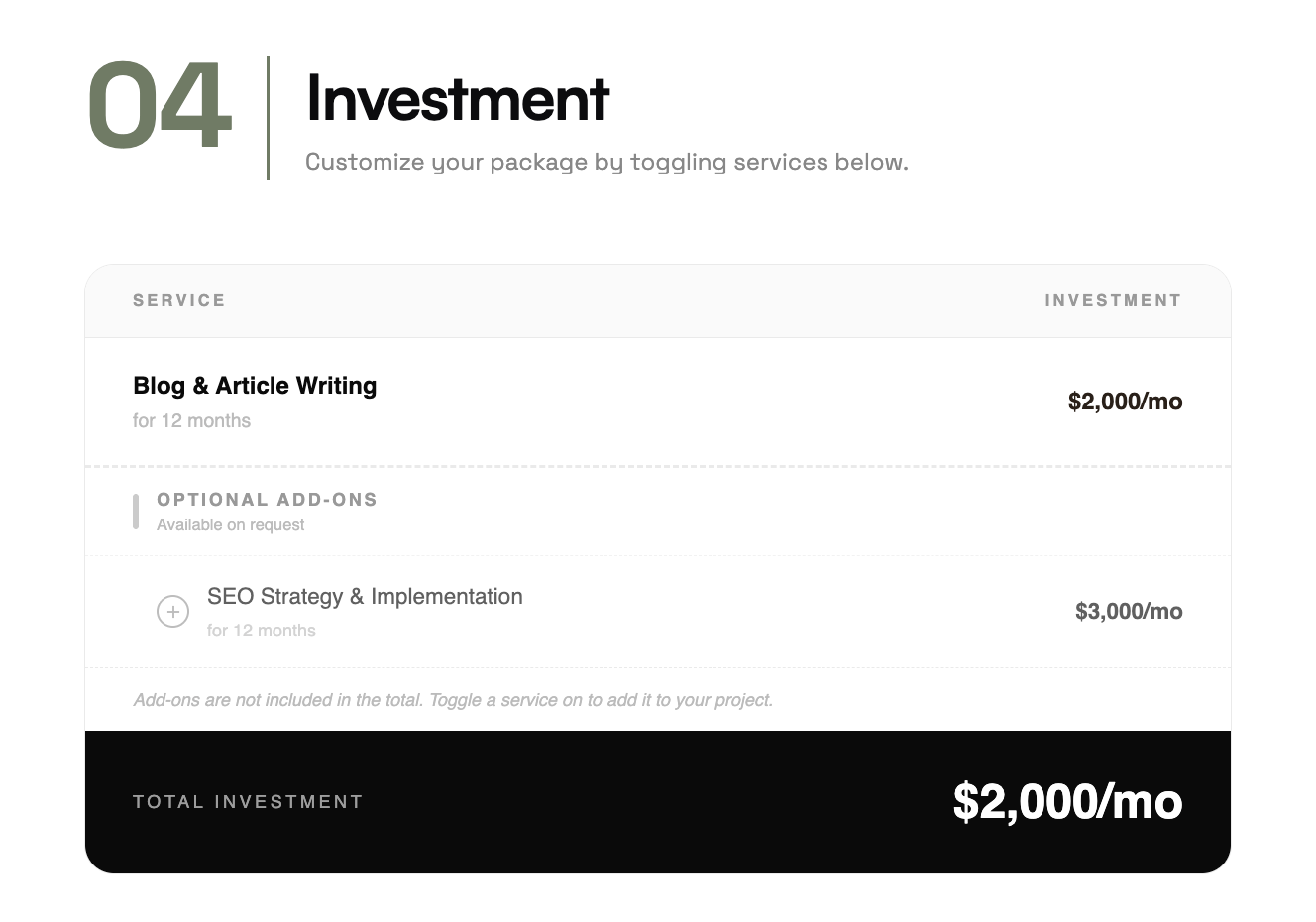
Offer a couple of optional add-ons. A few services the client can switch on, like extra content or paid ad management at a set monthly rate, give them a feeling of control over the total. They also create an easy way for the retainer to grow later without a new negotiation.
This blend of one-time and recurring pricing is completely normal for agencies, yet most proposal templates handle it badly. You end up wrestling with a spreadsheet or sending two separate documents, which splits the client’s attention at the exact moment you want it focused.
Free retainer proposal template
Below is a simple structure you can copy and fill in. It covers everything above without any fluff.
That outline works for most agency retainers, whether you are pitching SEO, social, design, or consulting. If you would like a branded, more professional version that fills itself in from your own services, Propopad can build one for you in about a minute. More on that below.
Free download
Retainer proposal template
A fill-in-the-blanks template with everything covered above. No email required.
Click to download (Word) ↓ Click to download (PDF) ↓
A filled-in example
Executive summary. Over the next twelve months we will grow Brightloop Media’s organic traffic and social presence through a managed monthly program, so your marketing keeps compounding without you having to run it day to day.
Included each month. SEO strategy and implementation, four optimized blog articles, twelve social posts across Instagram and LinkedIn, and a monthly performance report with a strategy call.
Out of scope. Paid ad spend, website development and one-off campaign creative. We are happy to quote these separately whenever you need them.
Term. Twelve months to start, then month to month with thirty days notice either way.
Investment. $4,500 onboarding and audit to begin, then $3,500 a month. Optional paid ad management is available at $1,500 a month.
Notice how little space that takes. It is short, it is specific, and a client can tell at a glance what they pay once and what they pay every month. That clarity is most of what makes someone comfortable committing for a year.
Marketing retainer packages
Most agencies sell one retainer and negotiate down from it. Offering two or three packages instead changes what the client is deciding: not whether to hire you, but which level to hire you at.
Three is the usual number. An entry package that covers the essentials, a middle one that most clients pick, and a larger one that makes the middle look reasonable. Name them after what they deliver rather than metals. "Foundation", "Growth" and "Scale" tell the client more than "Silver", "Gold" and "Platinum".
Vary the scope, not the effort. The difference between packages should be what the client gets: more channels, more content, faster reporting. Not how hard you promise to work. Effort is invisible and unenforceable; deliverables are neither.
Put the recommended one in the middle and say so. Clients want to be told which one fits. A single line closes more deals than a neutral comparison table: "Based on what you described in our call, Growth is the right starting point."
Price the gap deliberately. If the jump from Foundation to Growth is small, most clients take Growth. If it doubles, most take Foundation. The spacing between your packages is a pricing decision, not an accident.
Mistakes that cost you the deal
A few errors show up again and again, and each one quietly lowers your chances of a yes.
Vague monthly scope. If the deliverables are fuzzy, the client either hesitates or signs and then expects everything. Be precise about what lands each month, and just as precise about what does not.
Blending one-time and recurring costs. When a client cannot tell the setup fee from the monthly fee, the whole proposal starts to feel slippery. Always separate them.
Leaving the term open-ended. No defined length, no notice period, no renewal terms. That vagueness feels relaxed when you write it and causes friction the moment either side wants to change something.
Billing by the hour. It caps what you can earn and reframes a partnership as a timesheet. Price the monthly package and the outcome instead.
No obvious next step. A proposal that trails off without a clear way to accept just sits in an inbox. End with a signature line or an accept button so saying yes takes one click.
A faster way to build them
Writing all of this out for every prospect, formatting it, splitting the pricing, and keeping each version consistent, takes real time. Send a few proposals a month and it quietly eats a working day.
Propopad is marketing proposal software that takes that work off your plate. You set your services up once, then pick the ones a client needs and the proposal assembles itself, including the retainer pricing. A one-time onboarding fee and a monthly retainer can live in the same proposal, with optional add-ons the client can switch on and the totals worked out for you. When the client is ready, they accept and sign without leaving the document or waiting on a separate contract.
It is built for small agencies, so the pricing is flat for your whole team with no per-seat fees, and your first proposal is free with no credit card.
Build your next retainer proposal in minutes
Propopad handles retainer and project pricing in one proposal. Scan your website, pick your services, then review the draft. No credit card required.
Stop writing proposals from scratch
Propopad scans your website and turns your services into a branded proposal in minutes.
Keep reading
Agency Pricing Models: How to Price Services in a Proposal
The pricing models agencies actually use: retainer, project and tiered packages. Plus how to present them in a proposal so the client says yes to the price.
Marketing Proposal: Template, Example and How to Write One
A marketing proposal template and worked example, plus the 9 sections that win the deal, from cover page through signature, with pricing clients say yes to.