
Knowing how to price agency services is one thing. Presenting that price inside a proposal so the client says yes is something else entirely. You have a pricing model. You know what your services cost. But every time you sit down to write the proposal, the same doubts come back: is this too high? Too low? Should I show the breakdown or just the total? What if they compare me to a cheaper agency?
The truth is, most agencies don’t lose deals because their price is wrong. They lose deals because of how the price is presented. Two identical $15,000 proposals can feel completely different to a client depending on the structure and where it sits in the document. This guide covers how to price agency services in a way that actually closes deals, not just the math behind the number.
In this guide11 sections
- 01The four agency pricing models
- 02How much do marketing agencies charge per month?
- 03Sell outcomes, not hours
- 04The discovery conversation
- 05Anchoring the price
- 06Structuring the investment section
- 07Tiered pricing
- 08Retainer vs. project
- 09Handling “too expensive”
- 10Five pricing mistakes to avoid
- 11Final checklist before you send
The four agency pricing models
Almost every agency price is built on one of four models. Picking the right one matters more than the number you land on, because the model decides what the client thinks they are buying.
Hourly. You charge for time spent. It is the easiest to explain and the worst for you: it caps your income at the hours in a week, and it punishes you for getting faster. Clients also hate it, because the total is unknowable until the work is done.
Project. A fixed fee for a defined scope. Good for one-off work with a clear finish line: a website build, a brand identity, a campaign launch. The risk sits with you, so the scope has to be tight.
Retainer. A recurring monthly fee for ongoing work. Predictable for both sides, and the model most agencies want more of. Best for work that has no natural end: SEO, paid social, content, maintenance.
Tiered or value-based. You price the outcome rather than the input, usually as two or three packages at different levels. This is where agencies make the most margin, because the price is anchored to what the result is worth to the client rather than what it costs you to produce.
Most agencies end up using two or three of these at once. A project fee to start, a retainer to continue. The rest of this guide is about presenting whichever you choose so the client says yes.
How much do marketing agencies charge per month?
There is no single right number, and any article that gives you one is guessing. What you can do is build the number honestly, and defend it when asked.
A monthly retainer is usually the sum of three things: the cost of the people doing the work, the overhead that keeps your agency running, and the margin you need to stay in business and reinvest. If you know those three, you know your floor. That is the number below which the work is not worth taking.
The ceiling is set by something else entirely: what the outcome is worth to the client. An agency that reliably adds $40,000 a month in revenue can charge considerably more than one that produces the same deliverables with no measurable result. This is why the pricing conversation and the discovery conversation are the same conversation.
Two practical rules. Never quote a monthly number before you understand what the client is trying to achieve. You will anchor low and spend the rest of the engagement regretting it. And always tie the retainer to a defined set of deliverables, not to a vague sense of availability, or you will be asked for more work at the same price within three months.
Sell outcomes, not hours
The biggest pricing mistake agencies make has nothing to do with the number. It happens when you frame your services as hours and tasks instead of results and outcomes.
When a proposal shows “40 hours of SEO work at $150/hour,” the client reads a cost sheet. They start questioning whether each task really takes that long. They compare your hourly rate to a freelancer on Upwork. You have lost control of the conversation before it started.
When the same proposal shows “SEO Strategy and Implementation: $3,500/mo, including technical audit, keyword research, on-page optimization, and monthly reporting,” the client reads a solution. The question shifts from “is $150/hour worth it” to “is this outcome worth $3,500 a month.”
This is why the best agencies label their pricing section “Investment,” not “Pricing” or “Fees.” It is not a semantic trick. It reframes the entire evaluation. The client weighs the total against what they will get, not against how you spend your time.
Quick test: Open your last proposal. If the pricing section is called “Pricing,” “Fees,” or “Cost Breakdown,” rename it to “Investment.” If it shows hourly rates anywhere, remove them. These two changes alone will shift how clients evaluate the number.
The discovery conversation
The agencies that rarely get pushback on pricing are not the cheapest ones. They are the ones that had a strong discovery call before writing the proposal.
Discovery is where you learn what the client is actually trying to achieve, what they have tried before, what their budget range is, and how they will measure success. Without this information, you are guessing at a number and hoping it lands.
Three questions that change the pricing conversation:
“What would success look like for this project in six months?” This tells you what outcome to anchor your price to. If the answer is “double our organic traffic,” you can frame your SEO retainer as the path to that specific goal, not just a list of tasks.
“Have you worked with an agency before? What worked and what didn’t?” This reveals their expectations around pricing and scope. If their last agency underdelivered at $2,000/mo, your $4,000 proposal with a clear scope and reporting cadence suddenly looks like the smart choice, not the expensive one.
“Do you have a budget range in mind for this?” Many agency owners avoid this question, but it is the single most effective way to prevent sticker shock. If their ceiling is $3,000/mo and your services start at $5,000, you both save time by knowing that upfront. If their range is $5,000 to $8,000, you can build a tiered proposal that meets them where they are.
Anchoring the price
Anchoring means giving the client a reference point for your price before they reach the investment section. Without an anchor, clients compare your price to whatever number they had in their head, which is usually lower than what you are about to propose.
The best place to anchor is the executive summary at the top of your proposal. If the engagement is a $3,500 landing page build plus a $5,500/mo retainer, the executive summary should mention both the total investment and the expected outcomes: “We recommend a 4-week build phase followed by a 6-month SEO retainer. The total investment is $3,500 plus $5,500 per month, which positions Brightloop to see meaningful growth in organic traffic within the first quarter.”
By the time the client scrolls to the full investment section, the number is familiar. They are evaluating the details, not reacting to a surprise. Proposals where the executive summary mentions the investment have a much higher close rate than proposals where the price appears for the first time on the last page.
Related: For a full walkthrough of every section your proposal needs, including the executive summary, read our guide on how to write a marketing proposal that wins clients.
Structuring the investment section
The investment section is the most scrutinized part of any agency proposal. Clients re-read it, forward it to a partner or CFO, then compare it against other proposals. The structure needs to be clear enough that someone who skipped every other section can still understand what they are paying for.
Here is the format that works for most agency engagements:
If you are selling a one-time project, list each deliverable with its price and include a subtotal. Keep descriptions short. The detailed scope should live in its own section earlier in the proposal. The investment section just attaches a number to each item.
If you are selling a monthly retainer, show the monthly rate, the duration of the commitment, and what is included. A retainer that says “$4,000/mo” with no context feels expensive. A retainer that says “$4,000/mo for 6 months, including technical SEO audit, keyword strategy, on-page optimization, and monthly reporting” feels like a clear commitment with defined value.
If you are selling a mix of project and retainer, separate them visually. List one-time project fees first with their own subtotal, then monthly retainers with their own subtotal. At the bottom, show a combined total that makes the full investment unmistakable. Something like “$3,500 project fees + $5,500/mo ongoing retainer.”
If you want to suggest additional services without inflating the main price, add them as optional items below the subtotals. The client can see what is available without the main number feeling bigger than expected.
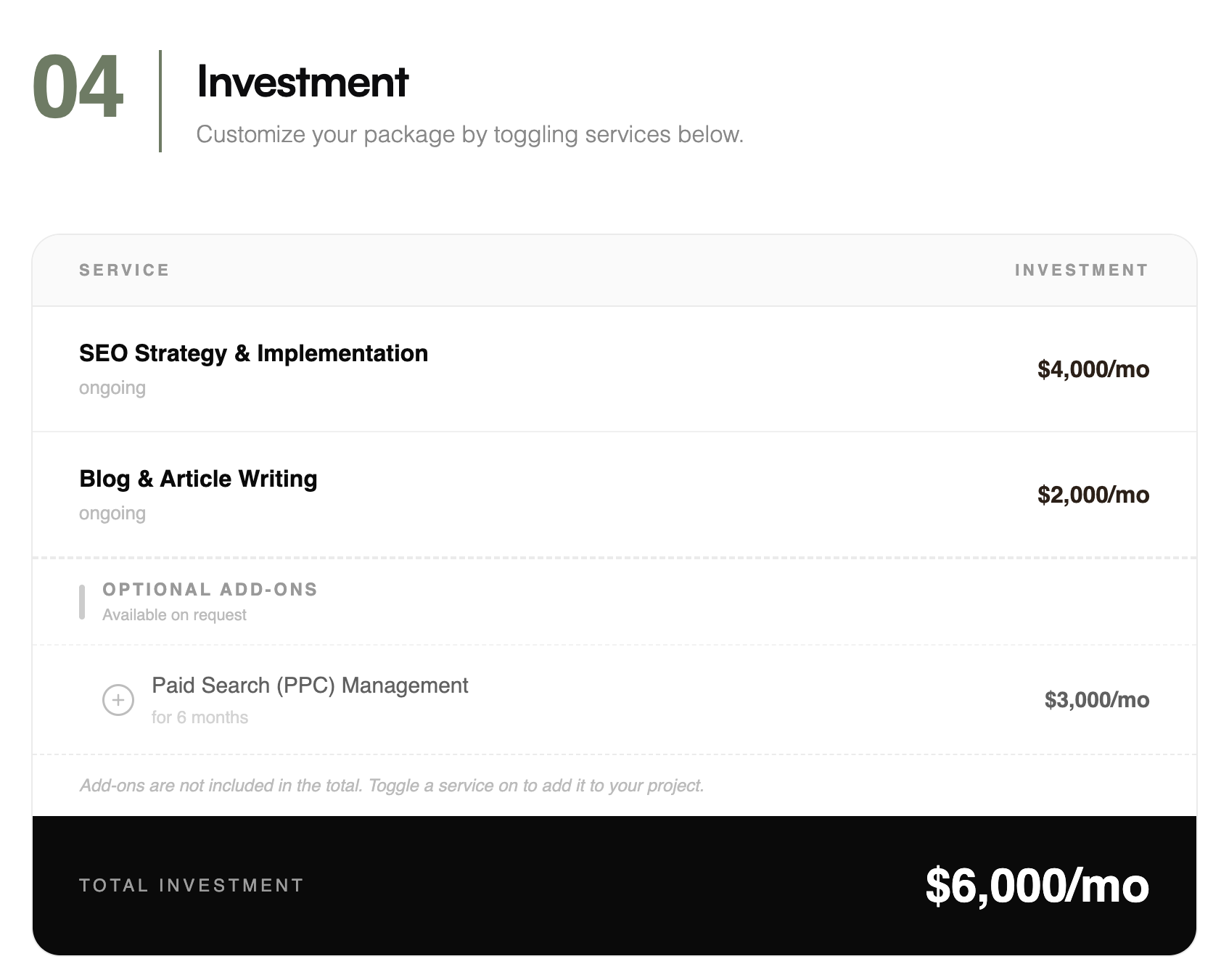
The total at the bottom should be impossible to misread. If your proposal includes a validity date (“This proposal is valid until May 17, 2026”), include it here too. It creates a natural deadline without being pushy.
Tiered pricing
One of the most effective pricing techniques in agency proposals is offering two or three options instead of a single price. This changes the client’s internal question from “should we hire this agency” to “which package fits us best.”
A strong tier structure uses three levels. The entry-level tier includes the core service. The mid-tier adds more value and is labeled “Recommended.” The top tier includes everything. For example:
Basic at $3,500/mo: SEO Strategy only. Essentials at $5,500/mo: SEO Strategy + Blog Writing. Complete at $8,500/mo: SEO, Blog Writing, + Paid Search Management.
The middle option should be the one you want most clients to choose. Labeling it “Recommended” gives them permission to pick it without overthinking. Clients who would have said no to a flat $8,500 proposal will often choose the $5,500 option because it feels like a deliberate decision rather than a take-it-or-leave-it price.
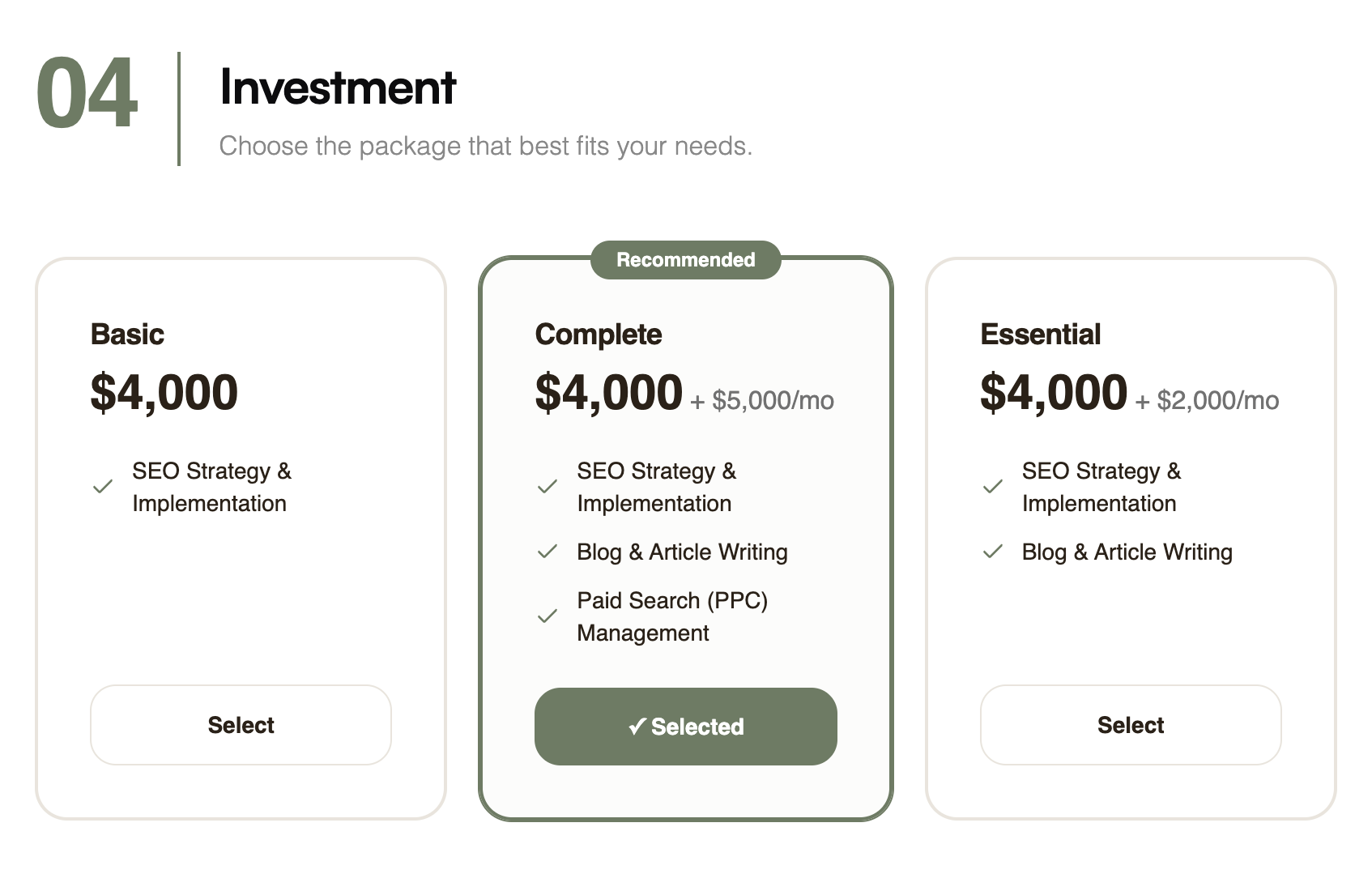
Keep package comparisons simple. The client should understand the difference between all three tiers in under 10 seconds. If they need to read paragraphs of fine print, you have too much detail in the package view. Save the full deliverable breakdown for your scope section.
Retainer vs. project
This decision is not just about your business model. It is about how the client thinks about the engagement and how they justify the spend internally.
Project pricing works when the work has a clear beginning and end. Website builds, brand identity packages, landing pages, and campaign launches all fit. The client wants to know the total cost upfront, and they expect a finished deliverable at the end. When figuring out how to price agency services on a project basis, watch your win rate. If you are winning more than 70% of your project quotes, your prices are probably too low.
Retainer pricing works when the value compounds over time. SEO, content writing, social media management, and paid ad management all get better the longer they run. A monthly fee makes sense to the client because the results build month over month. Always specify the minimum commitment length and what happens when the term ends. Vague retainers lead to scope creep conversations within the first 60 days.
Mixed pricing is the most common pattern for agencies. An initial build phase (project) transitions into ongoing management (retainer). A website redesign at $15,000 followed by $4,000/mo SEO is a natural pairing that reflects how the work actually flows. In your proposal, separate the two with their own subtotals so the client can see exactly what the upfront investment covers versus the ongoing commitment.
Handling “too expensive”
Every agency hears this, and the natural reaction is to either defend the price or offer a discount. Both are wrong first moves.
First, ask why. “Too expensive” can mean completely different things. It could mean the client has a lower budget than you assumed. It could mean a competing agency quoted less. It could mean they do not see enough value in what you described. Until you know the reason, you cannot respond effectively.
If their budget is genuinely lower, reduce the scope before you reduce the price. Remove services from the proposal rather than discounting the same package. This protects your margins and signals that your services have real value. A $3,500/mo retainer that includes SEO only is a better deal for you than a $5,500 retainer discounted to $3,500 that still includes SEO, content, and reporting.
If a competitor quoted less, do not race to match. Instead, highlight what is different about your approach. Agencies that compete on price attract clients who will leave for a cheaper option. Agencies that compete on outcomes attract clients who stay.
If they do not see enough value, the problem is in your proposal, not your price. Your executive summary, scope section, and case studies need to do the selling before the client reaches the number. If the investment section is doing all the heavy lifting, the rest of the proposal is not working hard enough.
Remember: Reduce scope, never price. If a client needs a lower number, remove deliverables instead of discounting the same package. This protects your margins and teaches clients that your services have a defined value.
Five pricing mistakes to avoid
1. Showing hourly rates
Unless the client specifically asked for hourly billing, exposing your internal rates invites line-item negotiations. Present the value of the deliverable, not the cost of your time. The moment a client sees “$150/hour,” the conversation shifts from “what will I get” to “how long will it take.”
2. Burying the price on the last page
Some agencies hide pricing deep in the proposal, hoping the strategy section will sell the client before they see the number. This backfires. Clients who cannot find the price quickly lose trust. Make your investment section clearly labeled and easy to navigate to.
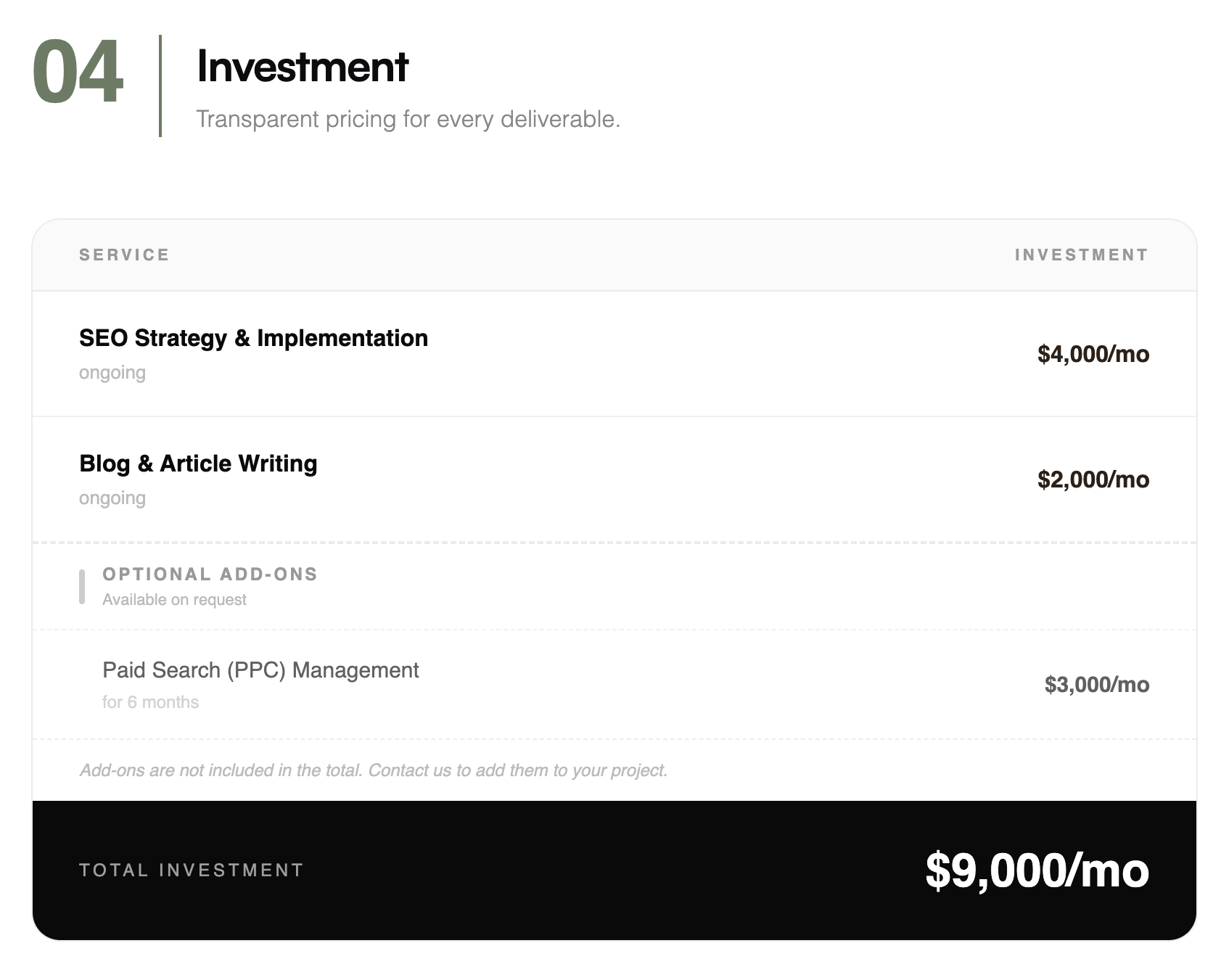
The bottom of your investment section should show the total in a way that is impossible to misread. For mixed proposals, use a format like “$3,500 project fees + $5,500/mo ongoing retainer.” For pure retainer proposals, show the monthly rate. For project-only work, show the one-time total.
If your proposal is valid for a limited time, add that here too. A simple line like “This proposal is valid until May 17, 2026” creates a sense of urgency without being pushy.
3. Showing one big number with no breakdown
A proposal that says “Total: $47,500” with no line items gives the client nothing to evaluate. They cannot tell what they are getting, which parts are optional, or where the money goes. Always break the total into named services with individual prices.
4. Using estimates instead of fixed prices
Price ranges like “$8,000 to $12,000” make clients nervous. If you do not know the price yet, you have not done enough discovery. A $4,000 gap in any currency is not insignificant. Ask the remaining questions, then commit to a number.
5. Sending the proposal too late
Data consistently shows that proposals sent within 24 hours of the client meeting convert at a significantly higher rate than those sent a week later. The excitement and momentum from the discovery call fades quickly. Price your services ahead of time so you can build and send proposals fast.
Final checklist before you send
Once you understand how to price agency services and structure your proposal, run through this final review before it goes out.
☐ The pricing section is labeled “Investment,” not “Pricing” or “Fees”☐ The executive summary previews the total investment and timeline☐ No hourly rates are exposed anywhere in the document☐ Project fees and monthly retainers have separate subtotals☐ Each service has a name, short description, and fixed price☐ Optional add-ons are clearly marked as not included in the total☐ The total is readable at a glance, with no calculator needed☐ A validity date is included☐ The proposal was sent within 24 hours of the client meeting
If you check all of these, your agency pricing proposal is doing its job: giving the client the confidence to say yes.
Build your next proposal in 60 seconds
Propopad handles fixed, retainer and mixed pricing natively. Tiered packages, add-ons and automatic totals are built in.
No credit card required. Your first proposal is free.
Keep reading
How to write a marketing proposal that wins clients
Stop writing proposals from scratch
Propopad scans your website and turns your services into a branded proposal in minutes.
Keep reading
Retainer Proposal Template: Marketing Retainer Packages
A free retainer proposal template, plus how to structure marketing retainer packages and price them so clients commit to a monthly fee without hesitating.
Marketing Proposal: Template, Example and How to Write One
A marketing proposal template and worked example, plus the 9 sections that win the deal, from cover page through signature, with pricing clients say yes to.